台博學程「華語電影專題」課堂專題演講
115-1 「華語電影專題」課堂專題演講
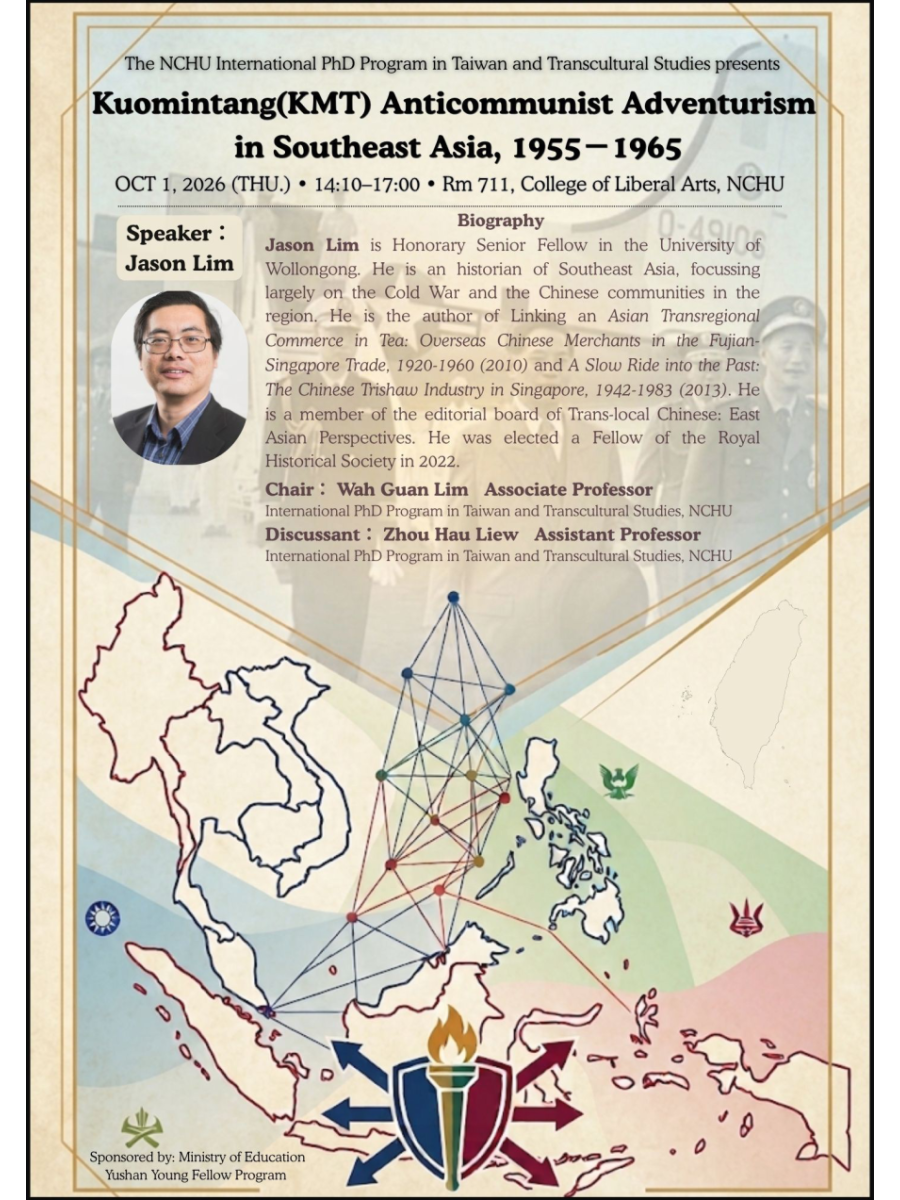
主題:Kuomintang(KMT) Anticommunist Adventurism in Southeast Asia, 1955-1965
時間:2026年10月1日(四)14:10-17:00
地點:人文大樓 A711 教室
講者:Jason Lim
Biography
Jason Lim is Honorary Senior Fellow in the University of Wollongong. He is an historian of Southeast Asia, focussing largely on the Cold War and the Chinese communities in the region. He is the author of Linking an Asian Transregional Commerce in Tea: Overseas Chinese Merchants in the Fujian-Singapore Trade, 1920-1960 (2010) and A Slow Ride into the Past: The Chinese Trishaw Industry in Singapore, 1942-1983 (2013). He is a member of the editorial board of Trans-local Chinese: East Asian Perspectives. He was elected a Fellow of the Royal Historical Society in 2022.
Abstract
The lecture talks about how the Kuomintang (KMT) regime involved itself in anticommunist activities in Southeast Asia. With the defeat of the KMT by the Chinese communists, it viewed with suspicion any calls for a “peaceful coexistence” with communism and considered nonalignment to be an unviable option for any state. In 1950, however, Burma, Indonesia and North Vietnam had recognized the People’s Republic of China (PRC). Cambodia opted for nonalignment and procured aid from the United States and China. Taiwan could count on support from Thailand and the Philippines as these states had recognized the Republic of China (ROC) before 1949. There were emerging states in the region for ROC (Taiwan) to promote its anticommunist agenda in 1955 – Laos, South Vietnam, Malaya (later Malaysia), and Singapore. What then was the KMT’s role in promoting anticommunist ideals in Southeast Asia? The goal is to understand Taiwan’s relationship with Southeast Asia – especially newly emerging states – as it went through decolonisation and conflict with local communist forces. How and what did the KMT do to increase its influence in Southeast Asia?
主持人:林華源 (國立中興大學台灣與跨文化研究國際博士學位學程副教授)
評論人:廖卓豪 (國立中興大學台灣與跨文化研究國際博士學位學程助理教授)
主辦:國立中興大學台灣與跨文化研究國際博士學位學程
協辦:教育部玉山青年學者計畫